Situated atop a huge volcanic basin, Yellowstone is home to thousands of active thermal features, including the world renowned Old Faithful Geyser. Yellowstone is also known for the spectacular Grand Canyon of the Yellowstone, which is 1200 feet deep and highlighted by the powerful Lower Falls. Yellowstone is also pristine mountain-range wilderness and an open refuge for wildlife, including grizzly bear, elk, American bison, moose and wolf. [www.yellowstone.net]
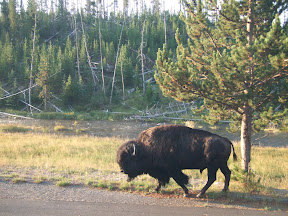
The first "sight seeing" that morning was the bison, this buffalo weighed approximately 2000 pounds. It was interesting to see it calmly grassing not far from the street. Later on that day, I saw another five buffaloes, so they had much population in this NP. Later on that day I also saw a grey wolf, a grizzly bear and some elks, but not a moose (at least not the living one, I saw a conserved one, it was as tall as a horse and big).
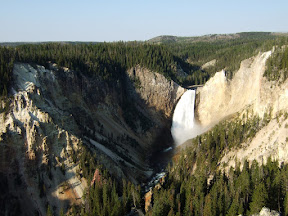
We visited first the Yellowstone Canyon and the Lower Yellowstone waterfall (308 ft / 94 m high). Then continued with the upper part (109 ft / 33 m high). They both are pretty.
One girl, named Yuan, got her foot slightly injured because she slipped in this place. But we continued to Mammoth Hot Springs, as she went to the hospital (she was ok after a while). We had two hours free to see the site and for lunch, so Julia and me decided to spend 1 hr 45 mins. to see the site. It had some beautiful terraces, with different characteristics.
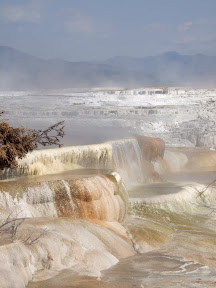
The step-like terraces form as heated water moves along the Morris-Mammoth Fault. The hot water carries dissolved calcium and bicarbonate to the surface of the terraces where pressure lessens. Carbon dioxide then escapes as gas and the carbonate combines with calcium to precipitate as travertine.
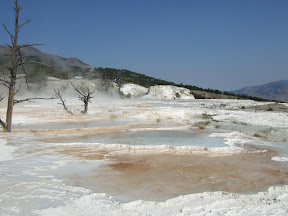
The Mammoth Terraces are constantly changing shape and color. Springs which were active one to five years ago may be dry and lifeless now, yet activity may later resume. Along with changes of thermal activity come changes in color. Fresh travertine is bright white in color and as it weathers it changes to gray. Bright colored cyanobacteria and algae mats which were dependent upon a stable temperature and a flow of water also change as the microorganisms die creating a stark, bleak landscape. [www.yellowstonenationalpark.com]
Then we hurried to the meeting point and took 10 mins to eat the burger (prepared by some students who do the summer job in Yellowstone NP). It was a good one. I also bought a scenery picture book, which was really nice, as a token for myself. I was content afterwards!
We continued to Grand Prismatic Spring which was rich in color: blue, yellow, orange and brown due to the heat-loving microbacterias which lives in the hot water. It was very3x beautiful.
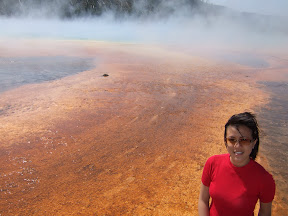
This spring was the largest and one of the most brilliant of Yellowstone's many colorful hot springs. It was approx. 200 ft / 61 m wide, and the water temperature was 160 F / 70 C, which makes it often cloaked in steam. The magma deep beneath it (from an active volcano), heated the waters that rises through the fissures in the rocks. The result was a hot spring that pours almost 500 gallons of hot water each minute into the Firehole River. [info board]
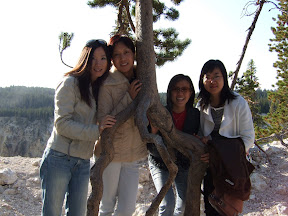
At this place me and the other three chinese girls were late to come back to the bus. So we had to sing a song as a punishment. We sang "Do Re Mi" from Sound of Music, which was easy. And since our voice was so good and everybody liked it, some of the tour members told us to be late again hihihi. It was a good tour, because all of the members are on time, the late was just about 5 minutes, definitely bearable.
But this time, our late was pretty critical - although not too long, because afterward we visited the "Old Faithful" Geyser. It may not be the highest geyser, but it was famous since it erupted every 60 - 90 minutes, and people could get the eruption prediction schedule at the Yellowstone info points. As we arrived, it was only 3 minutes before it really erupted. If we were late, we should wait for probably an hour for the next one. The duration of the eruption was about 2 minutes, and it was definitely more than 20 meters high. Cool!!!
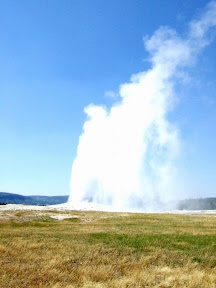
Old Faithful was named in 1870 during the Washburn-Langford-Doane Expedition and was the first geyser in the park to receive a name. An eruption can shoot 3,700–8,400 gallons (14,000–32,000 l) of boiling water to a height of 106–184 feet (30–55 m) lasting from 1.5–5 minutes. The average height of an eruption is 145 feet (44 m). [Wikipedia]
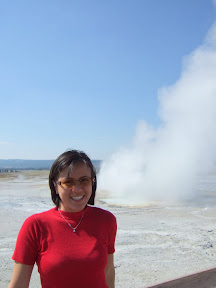
My last visit in Yellowstone was The Fountain Paint Pot area, in which one can see fumaroles (holes in a volcanic area which releases hot gases), mud pot (which looked like a pond containting boiling mud), Silex hot spring and a small geyser that erupted every minute (it actually did not stop at all in my visit).
At the end of the day we stayed at Ramada hotel in Pocatello. It was a very very beautiful day.

No comments:
Post a Comment